What Are Server Actions in Next.js? A Complete Guide to Using Server Actions
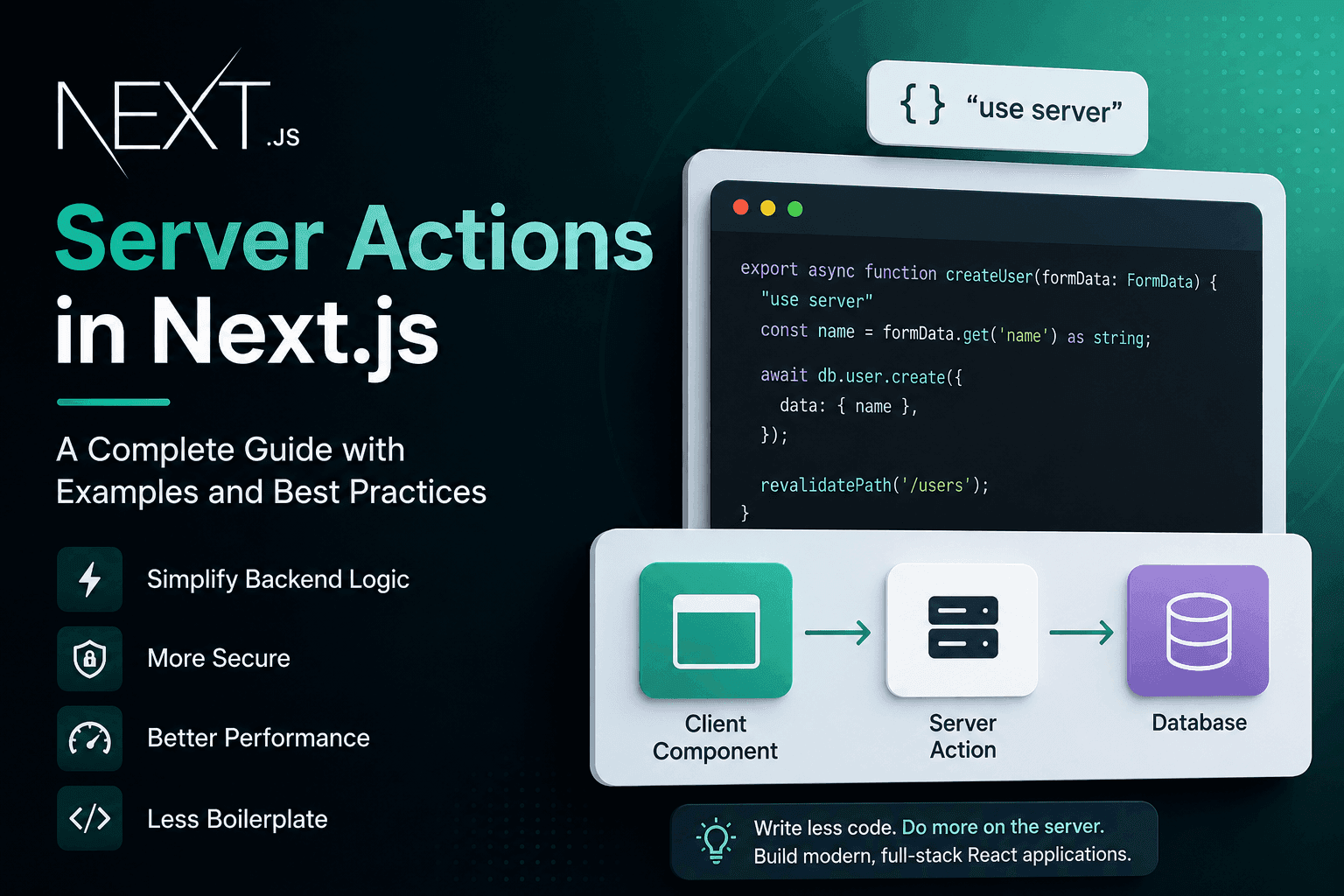
With the introduction of Next.js 13 and its continued evolution in newer versions, the Vercel team has worked to reduce the gap between frontend and backend development. One of the most significant features introduced along this journey is Server Actions. This capability allows developers to execute server-side operations directly from React components without the need to create separate API routes.
If you've previously had to build API endpoints, send requests with fetch, process data on the server, and return responses just to handle form submissions or database operations, Server Actions can dramatically simplify that workflow.
In this article, we'll explore what Server Actions are, how they work, their advantages and limitations, and practical examples of how to use them in real-world applications.
What Are Server Actions?
Server Actions are a feature in Next.js that allow you to execute server-side functions directly from React components.
In simple terms, instead of:
Creating an API Route
Sending a POST request
Processing the data on the server
Receiving a response
You can define a server-side function and connect it directly to a form or user interaction.
This approach reduces boilerplate code and improves the readability and maintainability of your application.
Why Were Server Actions Introduced?
In a traditional Next.js architecture, storing data in a database usually follows this flow:
Client Component → fetch('/api/users') → API Route → Database
With Server Actions, the process becomes much simpler:
Client Component → Server Action → Database
As a result, much of the complexity associated with managing API layers is removed, allowing developers to focus more on business logic.
Defining a Server Action
To create a Server Action, simply add the "use server" directive inside your function.
Example:
export async function createUser(formData: FormData) {
"use server";
const name = formData.get("name");
console.log(name);
// Save to database
}
The "use server" directive tells Next.js that this function must execute exclusively on the server.
Using Server Actions with Forms
One of the most common use cases for Server Actions is form handling.
Example:
import { createUser } from "@/actions/user";
export default function UserForm() {
return (
<form action={createUser}>
<input type="text" name="name" placeholder="Name" />
<button type="submit">Save</button>
</form>
);
}
When the form is submitted, the createUser function runs directly on the server.
Notice that there is no need for an onSubmit handler or a manual fetch request.
Connecting to a Database
The true power of Server Actions becomes apparent when combined with ORMs such as Prisma.
Example:
"use server";
import { prisma } from "@/lib/prisma";
export async function createUser(formData: FormData) {
const name = formData.get("name") as string;
await prisma.user.create({
data: {
name,
},
});
}
In this example, data is submitted directly from the form and stored in the database without creating an API Route or sending an additional HTTP request.
Validating User Input
A common misconception is that because form processing occurs on the server, validation is no longer necessary.
You should always validate incoming data.
Zod is an excellent choice for this purpose.
Revalidating Data After Mutations
Applications that rely on caching often need a way to refresh stale data after updates.
Next.js provides utilities such as revalidatePath for this scenario.
After the action completes, the cache for the specified route is invalidated, ensuring that users see the latest data.
Advantages of Server Actions
Reduced Boilerplate Code
No need to create and maintain numerous API routes.
Improved Security
Sensitive business logic remains on the server and is never exposed to the client.
Better Performance
By eliminating unnecessary HTTP requests, communication between the UI and server-side logic becomes more efficient.
Faster Development
Building forms and CRUD operations becomes significantly simpler and more productive.
Limitations of Server Actions
Despite their many benefits, Server Actions are not suitable for every use case.
Not Ideal for Public APIs
If your application needs to serve data to mobile apps or external services, traditional API Routes or REST APIs are still required.
Next.js Dependency
Server Actions are a framework-specific feature and cannot be used outside the Next.js ecosystem.
More Challenging Debugging
In some situations, debugging server-side execution can be more difficult than working with conventional API endpoints.
When Should You Use Server Actions?
Server Actions are a great choice for:
Form submissions
Authentication workflows
CRUD operations
Database interactions
File uploads
User profile updates
Admin dashboards
However, API Routes remain the better option for:
Public APIs
Webhooks
Mobile application integrations
Third-party services
Conclusion
Server Actions are one of the most impactful modern features in Next.js. They help bridge the gap between frontend and backend development by allowing server-side logic to be executed directly from React components.
If you're building applications with the App Router, Server Actions can make your codebase cleaner, easier to maintain, and more productive to work with. However, they are not a complete replacement for APIs, and each approach has its own strengths.
In many modern Next.js projects, combining Server Components, Server Actions, and Prisma creates a powerful architecture that improves both developer experience and application performance.